Caloric Restriction Is Not Fasting. They Are Not Even on the Same Planet.
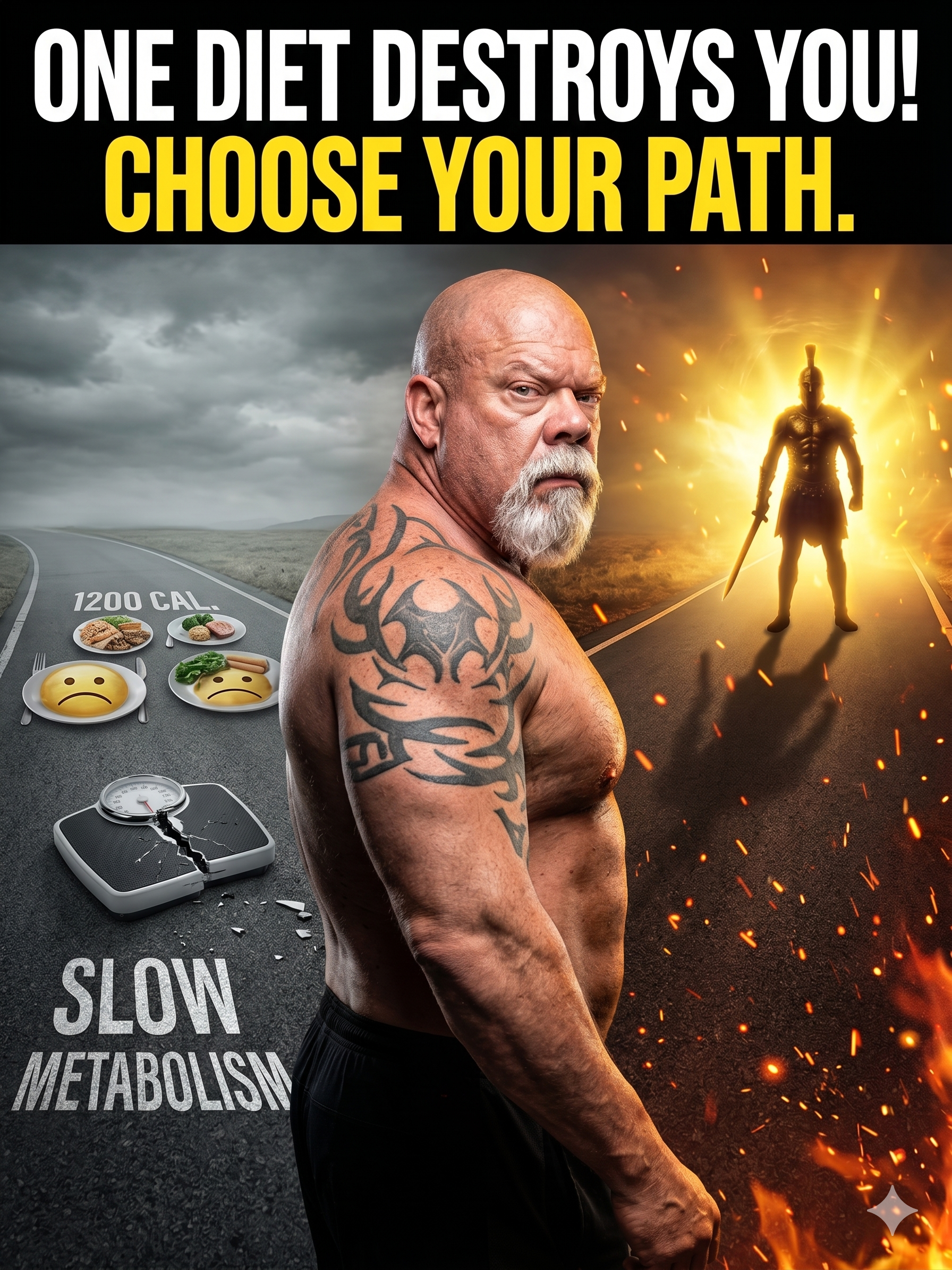
This is the most important thing you will ever read about losing fat. Not because I wrote it. Because once you understand what is in this article, you will never fall for another diet again. Because fasting is not a diet. It is a reckoning. You will never count another calorie. You will never buy another meal plan. You will never spend another dollar on a system that was designed to fail you from the start.
Here is the sentence that changes everything:
That is it. That is the whole thing. The rest of this article is the proof.
The Two Programs
Imagine your body is a company. You are the CEO. Revenue just dropped — which in this analogy means food intake just went down.
Now here is where it gets critical. How much the revenue dropped determines which program your body runs.
Program One: Caloric Restriction (The Downsizing Program)
You cut your food intake from 2,500 calories a day to 1,200 calories a day. Your body gets the message: revenue is down, but we are still operating. So it does what any struggling company does. It downsizes.
- It slows your metabolism. If you are only bringing in 1,200 calories, your body will adjust to burn 1,200 calories. Not immediately. But give it a few weeks. Your resting metabolic rate drops. Your body turns down the thermostat. You feel cold. You feel tired. You feel foggy. That is your body conserving energy because it thinks this reduced level of food is the new normal.
- It burns muscle. Your body looks at its assets and says: muscle is expensive. Muscle burns calories just sitting there doing nothing. If we are in a revenue crisis, we cannot afford expensive employees. So it lays off the muscle. Research shows that approximately 25 percent of weight lost through caloric restriction is lean mass — that is muscle and bone, not fat.
- It holds onto fat. Fat is cheap to store and calorically dense. In a downsizing scenario, fat is the emergency savings account. Your body does not want to touch it. It would rather burn muscle, slow your metabolism, reduce your energy, tank your mood, wreck your sleep, and make you miserable — all to protect the fat. Because fat is survival insurance, and your body thinks you are in a famine.
- Growth hormone stays flat or drops. There is no hormonal signal to protect lean tissue because the body is still receiving food. It does not need to switch into preservation mode. It just needs to cut costs.
This is what every diet does. Every single one. Weight Watchers. Jenny Craig. Noom. They all run the same failed program. The problem was never willpower. The Mediterranean diet. The Zone. South Beach. Keto with a caloric ceiling. If you are eating reduced calories, you are running Program One. The Downsizing Program.
Program Two: Fasting (The Sharpening Program)
You stop eating entirely. Zero calories. Not 800. Not 500. Not "just a little something." Zero.
Your body gets a completely different message: revenue did not drop. Revenue stopped. The company is closed. There is no food.
And here is what nobody tells you — your body does not panic. It does not shut down. It sharpens up.
- Metabolism stays elevated or increases. In the first several days of a complete fast, your resting metabolic rate does not drop. Studies show it can actually increase slightly. Why? Because your body is not in cost-cutting mode. It is in survival mode. It needs you sharp, alert, and physically capable of finding food. So it turns UP the furnace, not down.
- Growth hormone surges 300 to 500 percent. This is the big one. The Hartman et al. 1992 study, published in the Journal of Clinical Endocrinology & Metabolism, showed a five-fold increase in growth hormone after just two days of fasting. Growth hormone is the signal that tells your body: protect the muscle. Do not touch it. Burn the fat instead. Research published in Diabetes journal confirmed it — growth hormone during fasting specifically inhibits muscle protein breakdown. Your muscle is safe. It is locked down. The body burns fat and only fat for fuel.
- Fat becomes the primary fuel source. With no incoming calories and growth hormone protecting muscle, your body has one option: open the fat stores. And it does. Aggressively. Your liver begins converting stored fat into ketone bodies, which fuel your brain, your heart, your muscles — everything. And here is the kicker: your body produces more ketones than it needs. That surplus is your body burning hotter than normal. It is running at peak efficiency on its own stored energy.
- Autophagy activates. This is your body's cellular cleanup crew. It only activates during complete fasting. It recycles damaged proteins, broken organelles, loose skin collagen, malformed cell structures, and even pre-cancerous cells. You cannot get this on 1,200 calories a day. You cannot get this on any diet. You get it at zero.
- Inflammation drops to near zero. No food means no insulin spikes, no inflammatory response to digestion, no oxidative stress from processing food. Your joints feel better. Your brain clears up. Your skin improves. Everything that was inflamed starts to calm down.
Same body. Same person. Two completely different outcomes based on whether you ate a little or ate nothing at all.
The Biggest Loser Proved It
If you want proof that caloric restriction destroys your metabolism permanently, look no further than the most famous weight loss show in television history.
The Biggest Loser ran contestants through a 30-week program of extreme caloric restriction and brutal exercise. They ate around 1,000 to 1,200 calories a day while training six to eight hours a day with professional trainers. The results were dramatic. Contestants lost an average of 128 pounds during the competition. America cheered. The show was a hit.
Then the cameras turned off. And the science started.
In 2016, researcher Kevin Hall and his team at the National Institutes of Health published a landmark study in the journal Obesity — "Persistent Metabolic Adaptation 6 Years After The Biggest Loser Competition" (Fothergill et al. 2016). They tracked 14 of the original 16 contestants. Here is what they found:
of the 128 lbs lost
below what it should be — 6 years later
Read that again. Six years after the show ended, their metabolisms were still burning 500 calories per day less than they should have been. Their bodies never recovered. The downsizing program never turned off. They could eat what a normal person eats and still gain weight — because their bodies had been permanently recalibrated to a lower metabolic rate.
Thirteen out of fourteen contestants regained significant weight. Some ended up heavier than when they started the show. Not because they were lazy. Not because they lacked willpower. Because caloric restriction broke their metabolisms and their bodies never got the memo that the famine was over.
This is not an opinion. This is the NIH. Published. Peer-reviewed. Settled.
Why This Does Not Happen With Fasting
The Biggest Loser contestants ran Program One for 30 weeks straight. Reduced calories. Massive exercise. Their bodies adapted by downsizing — burning less, holding fat, sacrificing muscle. When they went back to normal eating, their bodies were still in downsizing mode. But now they were eating 2,500 calories with a metabolism that had been trained to function on 1,000. The math is a death sentence. The weight comes back. It always comes back.
During a complete fast, none of this happens. Your metabolism does not permanently downsize because the hormonal environment is completely different. Growth hormone is elevated. Norepinephrine is elevated. Your body is in hunting mode, not conservation mode. When you refeed after a fast, your metabolism is not suppressed. It rebounds. It comes back to baseline — or higher — because the hormonal signals that protect metabolic rate were active the entire time you were not eating.
That is the difference. It is not a small difference. It is not a nuance. It is the difference between a program that works and a program that destroys you.
What You Are Actually Burning
When most people think about fasting, they think about the fat they can see. The belly. The love handles. The double chin. And yes, you burn all of that. But what is happening inside your body during a complete fast is so much more profound than cosmetic fat loss.
Visceral Fat: The Fat That Is Killing You
The fat you can see in the mirror is subcutaneous fat — it sits under your skin. It looks bad, but it is not the one that kills you. The one that kills you is visceral fat. This is the fat that wraps around your internal organs — your liver, your kidneys, your heart, your pancreas.
Here is how it gets there. When you overeat, your body stores the excess energy as fat. First, it fills up the subcutaneous stores — the fat under your skin. But those stores have a limit. When they are full — when your body has stuffed as much fat under your skin as it can — the overflow has to go somewhere. So it starts depositing fat around your organs. This is called ectopic fat deposition.
Fat around your liver causes insulin resistance and fatty liver disease. Fat around your pancreas destroys your ability to produce insulin — hello, Type 2 diabetes. Fat around your heart increases your risk of atrial fibrillation and heart failure. Fat inside your muscles makes them resistant to insulin. This is not cosmetic. This is organ failure in slow motion.
The research from The Lancet Diabetes & Endocrinology (Neeland et al. 2019) confirms it: visceral and ectopic fat deposits are directly causal in the development of cardiovascular disease and metabolic syndrome. This is not correlation. This is causation.
Now here is the beautiful part. When you fast, visceral fat is targeted aggressively. Because it was the last fat deposited (your body filled the subcutaneous stores first and then overflowed to the organs), it is the first fat your body reaches for when it needs fuel. Your body knows that fat around your organs is dangerous. It prioritizes removing it. The fat choking your liver. The fat strangling your pancreas. The fat suffocating your heart. Fasting goes after all of it.
You cannot see this in the mirror. You cannot measure it on a bathroom scale. But it is the fat loss that saves your life.
Not Just Fat: What Else Your Body Burns
When autophagy activates during a complete fast, your body does not just burn fat. It burns everything that should not be there.
- Malformed proteins. Proteins that folded incorrectly and are clogging up cellular machinery. Gone.
- Damaged organelles. Mitochondria that are not functioning properly. Recycled.
- Loose skin. The collagen in loose, damaged skin is protein. Your body identifies it as expendable and recycles it. This is why people who lose weight through extended fasting have dramatically less loose skin than people who lose the same weight through caloric restriction or surgery.
- Pre-cancerous cells. Cells that are behaving abnormally but have not yet become tumors. Autophagy identifies them and eliminates them.
- Scar tissue. Old, fibrous tissue that no longer serves a purpose. Broken down and repurposed.
- Skin tags and benign growths. Unnecessary tissue that the body never had a reason to remove — until now.
This is not weight loss. This is a renovation. Your body is tearing down the damaged parts and rebuilding with new materials. You cannot get this on a diet. You cannot get this by eating 1,200 calories a day. You cannot get this from a pill. You get it from zero.
The Lie We Have Been Told
For decades, the nutrition establishment has told us that the way to lose weight is to eat less and move more. Create a caloric deficit. Count your calories. Track your macros. Eat six small meals a day to "keep your metabolism going."
This advice has produced the most obese population in human history.
The United States has followed this advice faithfully for forty years. We have more gyms, more diet programs, more calorie-tracking apps, more low-fat products, more sugar-free alternatives, and more nutrition information available than any society in the history of civilization. And we are fatter than ever. Seventy-four percent of American adults are overweight or obese. Seventy-four percent.
The advice does not work. The Biggest Loser proved it does not work. The science proves it does not work. Your own body has been proving it does not work every time you went on a diet, lost twenty pounds, gained back thirty, and blamed yourself.
It was never you. It was the program. You were running Program One in a body that was designed for Program Two.
The Side-By-Side
Here it is. Everything in one table. So simple a twelve-year-old can understand it.
| What Happens | Caloric Restriction (1,200 cal/day) | Complete Fasting (0 cal) |
|---|---|---|
| Metabolic rate | Drops. Adapts to match reduced intake. Can become permanent (Fothergill 2016). | Stays elevated or increases slightly in first days. No permanent suppression. |
| Growth hormone | Flat or slightly reduced. | Up 300-500% by day 2 (Hartman et al. 1992). Protects muscle. |
| Muscle | ~25% of weight lost is lean mass. Body cannibalizes muscle to conserve energy. | Protected by growth hormone. Body burns fat, not muscle. |
| Fat burning | Body reluctantly burns some fat while hoarding the rest. | Fat is the primary and almost exclusive fuel source. |
| Insulin | Drops partially but still spikes with each meal. | Drops to lowest possible levels. Insulin resistance reverses. |
| Autophagy | Minimal to none. Incoming nutrition suppresses it. | Activates at 24-48 hours. Peaks at 48-72 hours. Sustained during extended fast. |
| Ketone production | Low. Body is still running primarily on glucose from food. | High. Brain and body switch to ketone fuel. Surplus produced. |
| Inflammation | Reduced slightly but still present from digestion and insulin. | Drops to near zero. No digestive inflammation. No insulin spikes. |
| Visceral fat | Some reduction, mixed with muscle loss. | Aggressively targeted. Prioritized by the body. |
| After you stop | Metabolism stays suppressed. Weight comes back. Often more than before. | Metabolism rebounds to baseline. Hormonal reset complete. |
| Hunger | Constant. Ghrelin never resets. You are hungry all day every day. | Waves that pass in 20 minutes. Ghrelin resets after day 2-3. Hunger decreases. |
| Cost | Meal plans, apps, prepackaged food, supplements, coaching. | $0. You buy nothing. You eat nothing. You save money. |
The Hospital Bed
Here is the conversation nobody wants to have.
Yes, hunger is uncomfortable. Yes, it is hard to say no to food when everyone around you is eating. Yes, there are moments during a fast when your body screams at you to eat and your brain invents reasons why you should.
But let me ask you something.
Is hunger worse than a hospital bed?
Because that is where this ends if you do not change. The visceral fat around your organs does not care about your feelings. It does not care that you are busy. It does not care that your kids have soccer practice and you do not have time to think about your health. It just keeps accumulating until something breaks.
Heart attack. Stroke. Type 2 diabetes. Kidney failure. Joint replacement. Sleep apnea. Fatty liver disease. Blindness from diabetic retinopathy.
And when you are in that hospital bed — you will not be eating what you want anyway. You will be eating hospital food through a tube or off a tray. You will have no choice at all. Someone else will be telling you what you can and cannot eat. Someone else will be managing your body because you did not.
So the question is not "can I handle being hungry for a few days." The question is: do I want to choose hunger now, or have it chosen for me later in a bed I cannot get out of?
Fasting is a choice. A hospital bed is not.
What Your Stored Fat Actually Is
We need to change the way we think about body fat. We have been conditioned to see it as a failure. As evidence that we are weak. As something shameful that needs to be hidden under loose clothing.
Your body fat is not a failure. It is a fuel tank.
Every pound of body fat contains approximately 3,500 calories of stored energy. If you weigh 300 pounds and you should weigh 200 pounds, you are carrying 100 pounds of extra fat. That is 350,000 calories of stored energy. At a metabolic burn rate of 2,500 calories per day, that is 140 days of fuel. Your body has enough energy stored on it right now to power you for over four months without a single bite of food.
You are not fat. You are overfueled. And the only way to use that fuel is to stop adding more.
When you fast, you are not starving. You are switching from external fuel (food) to internal fuel (stored body fat). That is literally what body fat exists for. That is its biological purpose. Your body stored it specifically so that it could be used during periods of no food intake. Every pound of it. Every ounce. It is waiting to be burned. It has been waiting your entire life.
Watch the Show
If you have never watched My 600-lb Life, watch one episode. Just one. Watch what happens to a human body when fat storage has been pushed beyond all limits.
When subcutaneous fat stores are full and visceral fat stores are full, the body has nowhere left to put the excess. So it creates massive lipedemas — pockets of fat that hang off the body. It deposits fat in places that were never designed to hold it. Inside muscles. Around arteries. In the lining of the gut. The body is screaming for help and the person keeps eating because the addiction is that powerful.
These people are not weak. They are not lazy. They are addicted. And the medical system's answer is usually bariatric surgery — which is forced caloric restriction by mechanical means. Shrink the stomach so they physically cannot eat as much. Run Program One by force.
And the long-term success rate of bariatric surgery? Roughly fifty percent of patients regain significant weight within five years. Because the signal was never changed. The metabolism was never reset. The addiction was never addressed. They just made the downsizing program permanent by removing part of the stomach.
Fasting addresses the signal. Fasting changes the program. Fasting does not just reduce the amount of food going in — it eliminates it entirely and triggers a completely different hormonal and metabolic response. One that burns fat, protects muscle, reverses insulin resistance, clears visceral fat, activates cellular repair, and resets the metabolic set point.
No surgery. No drugs. No subscription. No meal plan. No app. No coach.
Just zero.
Wake Up
You have been lied to for your entire life. Not by people who wanted to hurt you — by people who did not know any better, and by industries that profit from your confusion.
The food industry profits when you eat. The diet industry profits when you eat less. The pharmaceutical industry profits when eating less does not work and you need drugs. The surgical industry profits when the drugs do not work and you need your stomach removed. Every single player in this system profits from you NOT understanding the difference between caloric restriction and fasting.
Because fasting is free. And free does not generate revenue.
But free works. The science says it works. The biology says it works. The human body — which evolved over two million years in an environment where extended periods without food were the norm — says it works.
Stop counting calories. Stop buying programs. Stop blaming yourself for failing at systems that were designed to fail.
Stop eating. Let your body do what it was built to do. Let it burn the fuel it has been storing for this exact purpose. Let it heal. Let it rebuild. Let it sharpen up.
Caloric restriction and fasting are not the same thing. They are not in the same ballpark. They are not on the same planet. One is a slow death of your metabolism. The other is its resurrection.
Burn the boats.