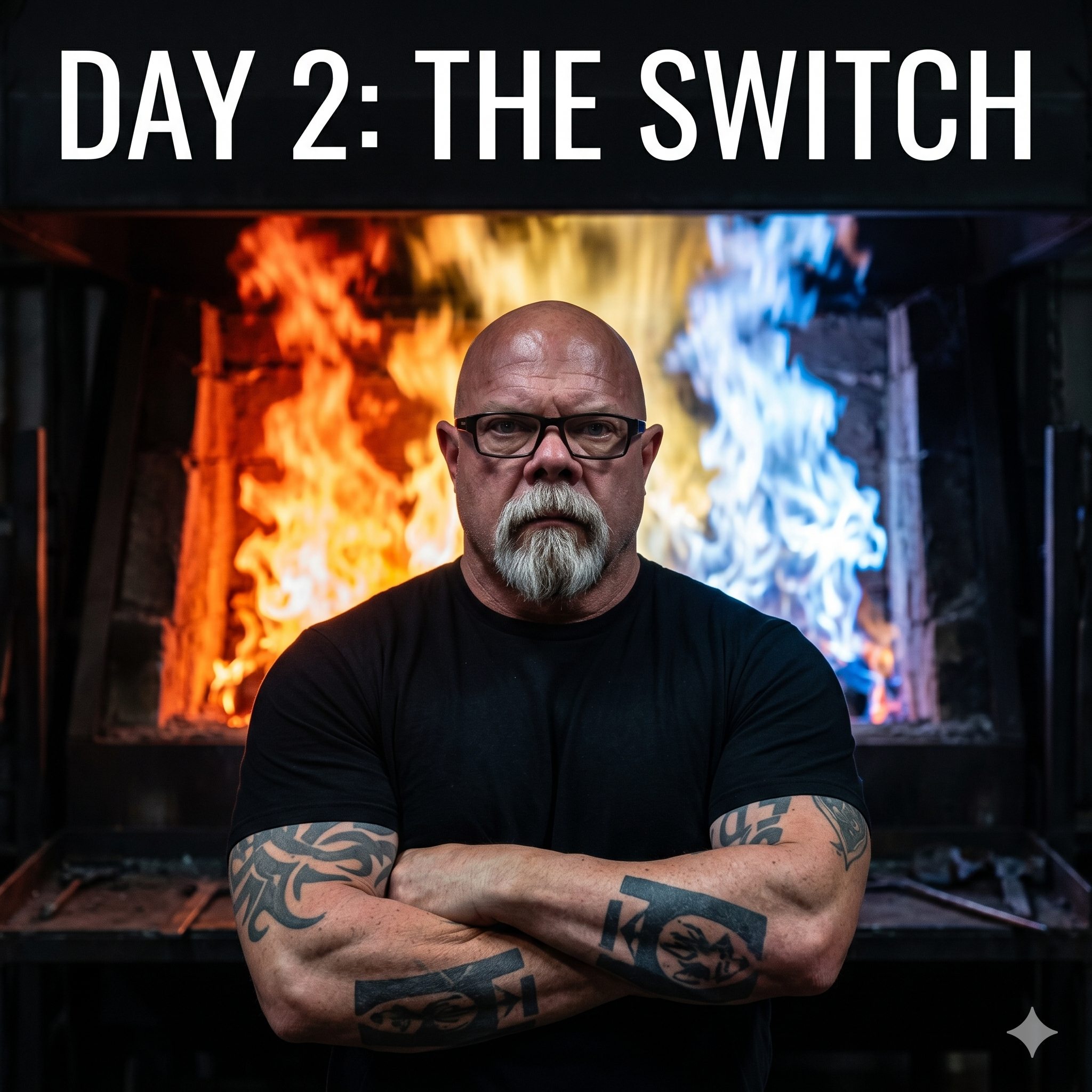
The Furnace Is Switching Fuels
I'm warm. Not sick warm. Not fever warm. More like someone turned a dial inside my chest and the pilot light caught something different. My skin feels like it is running a degree hot. My patience is thinner than usual. The edges of everything feel sharp and close.
This is the switch.
Day 2. Forty-eight hours since my last meal. Chinese food on my 57th birthday. The irony of a farewell dinner that was literally fried, sauced, and sugared is not lost on me. My body ran on that fuel for decades. Glucose on demand. Bread, rice, pasta, sugar, repeat. An endless conveyor belt of cheap energy fed directly into a furnace that never had to work for it.
Now the conveyor belt stopped. And the furnace is panicking.
Keto Flu, Fasting Flu, or Something Nobody Named Yet
People in the low-carb world call this the keto flu. The headaches. The brain fog. The irritability. The fatigue that sits on your shoulders like wet concrete. They blame it on the transition from glucose to ketones. Electrolyte shifts. Glycogen depletion. And all of that is real.
But something does not track.
Keto flu happens when people swap carbs for fat on their plate. They are still eating. Still getting calories. Still providing fuel. They just changed the type. Like switching from gasoline to diesel in an engine that was built for both but only ever ran on one. There is a transition period. The engine knocks. It coughs. It runs rough for a few days. But fuel is still coming in.
I have no fuel coming in.
Zero. Not low carb. Not high fat. Not anything. My body is not switching from external glucose to external fat. My body is switching from external fuel to internal fuel. From food on a plate to fat on my frame. From calories I chewed to calories I stored. This is not a fuel type swap. This is the equivalent of pulling the car over, popping the hood, and telling the engine to start burning its own parts to keep running.
That is a different metabolic event. And I am not sure the term "keto flu" does it justice.
Think about what the body is actually doing right now at the cellular level. For 57 years, every cell in my body has received a steady supply of glucose. The mitochondria, the power plants inside every cell, have been running on that glucose like a factory running on grid power. Predictable. Constant. Always available. The factory never had to install a generator because the grid never went down.
The grid just went down.
Every mitochondrion in my body is now scrambling to switch from glucose oxidation to fatty acid oxidation. This is not flipping a switch. This is rewiring the entire power grid of a factory while the factory is still running. The enzymes required for fat metabolism have to be upregulated. The transport proteins that carry fatty acids into the mitochondria have to be manufactured in greater quantities. The liver has to ramp up ketone production from near zero to full output. Ketone bodies, beta-hydroxybutyrate, acetoacetate, acetone, all of them have to flood the bloodstream in quantities the brain can actually use as fuel.
This does not happen in an hour. It takes days. And during those days, the body is running on fumes. Not quite glucose anymore. Not fully ketones yet. Stuck in the gap between two fuel systems, burning whatever it can find to keep the lights on. That gap is where I am right now. And the gap is where it hurts.
What I am feeling right now might be closer to full withdrawal. Not just from carbohydrates. From eating itself. From the mechanical act. From the ritual. From the dopamine hit that fires the second food touches the tongue. From the entire neurological cascade that begins when the brain detects incoming calories and starts the reward loop. That whole system just went silent. Not dimmed. Silent.
Withdrawal is withdrawal. The substance is different, but the neurology is identical. When a nicotine addict quits cold turkey, the acetylcholine receptors that were being artificially stimulated suddenly have nothing binding to them. The brain screams. When an alcoholic goes dry, GABA receptors suppressed by ethanol suddenly rebound. The brain screams. When a food addict stops eating entirely, the dopamine reward pathway that was being hammered by ultra-processed carbohydrates and sugar suddenly goes quiet. The brain screams the same scream. Different drug. Same circuitry. Same withdrawal.
The warmth I feel right now. The edginess. The low-level irritation that has no target and no name. This is my nervous system recalibrating. It has been running on glucose for 57 years. It does not know what to do with the silence.
But I do.
I sit in it.
Escape Velocity
There is a concept in physics called escape velocity. It is the speed an object must reach to break free of a gravitational field without further propulsion. For Earth, that number is about 25,000 miles per hour. Anything less and you fall back. Every time. No matter how high you get. If you do not hit that speed, gravity wins.
I have been launching rockets for years. Fast after fast. Three days here. Five days there. Seven. Ten. I get altitude. I see the curve of the Earth. I feel the pull weakening. And then something happens. Friction. Drag. A fight at home. A social event. A moment of weakness dressed up as a moment of celebration. And the rocket stalls.
And I fall back.
Every single time.
The pattern is so consistent it has its own choreography. The tension builds. An argument. Stress in the house. Then the resolution comes, and resolution always comes with food. Pizza. Something warm and shared and comforting. Something that says "we are okay now." Something that tastes like peace.
Except it is not peace. It is sabotage wearing the mask of love.
Not intentional sabotage. Nobody is trying to destroy anyone. But the pattern is the pattern. The tension creates vulnerability. The vulnerability creates the opening. And food walks right through it like it has a key to the front door.
I have given food that key my entire life.
Not this time.
Here is what I have learned from every failed fast. The failure point is never about hunger. By Day 3 or 4, the physical hunger is gone. The ghrelin waves flatten out. The body adapts. The stomach stops growling. If hunger were the enemy, every fast would succeed past Day 4. But they do not. Because the enemy is not hunger. The enemy is context.
Context is the birthday party where everyone is eating cake. Context is the restaurant with friends where you sit with water while they eat pasta. Context is the late-night kitchen when the house is quiet and the refrigerator hums in the dark and nobody would know. Context is the fight that ends with "let's just order something and forget about it." Context is the thousand invisible triggers that have nothing to do with your stomach and everything to do with your environment.
Short fasts do not give you enough time to encounter those contexts and survive them. Three days is easy if you lock yourself in a room. But you do not live in a room. You live in a world that runs on food. And if you do not practice surviving that world without eating, you never build the muscle. You never develop the callus. You never learn that the context is survivable. You just avoid it for a few days and then go back to the same life that made you 310 pounds in the first place.
Forty-one days forces me to encounter every context. Every social event. Every family meal. Every fight. Every celebration. Every boring Tuesday night when eating is just something to do. I have to sit through all of them without eating. And each one I survive becomes evidence. Proof that the context is not fatal. Proof that the craving passes. Proof that I can exist in the world without the substance.
That is what escape velocity looks like in practice. Not just duration. Exposure. Repeated exposure to the triggers without giving in. Until the triggers lose their charge.
This time I need to hit escape velocity. Not three days of altitude. Not seven. Forty-one. I need to get so far from the gravitational pull of my old patterns that falling back is no longer physically possible. I need to reach a point where the person sitting in this chair is not the same person who ordered Chinese food on April 13th. Not metaphorically. Metabolically. Neurologically. Structurally.
The "One More" Lie
Here is the framework that lives in my head tonight. The one I need to write down because it is true and nobody says it this way.
Every addiction ends the same way. One of two endings. You quit, or it quits you. And the terrifying part is you never know which "one more" is the last one.
One more cigarette gives you lung cancer. Not the 10,000th cigarette. That specific one. The one that mutated that specific cell in that specific bronchial tube on that specific Tuesday afternoon when you were stressed about bills and lit up in the parking lot. You had 10,000 chances to stop before that one. You did not take them.
One more donut pushes your pancreas past the tipping point into type 2 diabetes. Not "donuts in general." That donut. The one at the office meeting that you grabbed because everyone else was grabbing one and you told yourself you would start Monday.
One more bagel. One more plate of pasta. One more binge at midnight standing in front of the refrigerator in the dark. One more and the arterial plaque that has been building for 20 years finally blocks the flow. One more and the heart attack happens at 58 instead of 78. One more and someone finds you on the kitchen floor next to an open bag of chips.
One more drink and the liver that has been compensating for years finally stops compensating. Cirrhosis is not a cliff you fall off. It is a slope you slide down. But there is one specific drink that crosses the line from reversible to irreversible. You never know which drink it is. Nobody tells you. There is no warning. No alarm. No blood test that says "this is your last safe one."
One more hit and the aneurysm that was already weakening finally ruptures.
One more. Always one more.
The addict's prayer is always the same: "Just this once. I will start again tomorrow." And tomorrow comes 10,000 times until it doesn't.
Every relapse follows four stages. The Seed: a thought that arrives uninvited. "I could eat right now." Just a thought. Harmless. The Negotiation: the thought grows legs. "I have been good. I deserve this. I will fast longer tomorrow. It is just one meal." The brain becomes a defense attorney arguing for its own destruction. The Act: the food is in your hands. The taste hits. The dopamine fires. For 90 seconds, everything is perfect. The Morning After: the shame. The bloat. The broken promise. The starting over. Again. The most dangerous part is The Negotiation, because that is where intelligence becomes the enemy. The smarter you are, the better arguments you build for your own relapse.
Nobody Hands You the Cake and Calls It Recovery
Here is the part that makes food addiction the hardest addiction on the planet. The social infrastructure is built against you.
If you are a recovering alcoholic, people understand. They remove the bottles from the table. They order you a club soda without making a thing of it. They do not slide a glass of whiskey across the bar and say "come on, just one, you have been so good." They do not bring a case of beer to your house as a gift. They do not show up to your kid's birthday party and pressure you to take a shot because "everyone else is." The social contract around alcohol recovery is clear: we do not offer the substance to the person in recovery. Period.
Food addiction has no such contract.
People will bring donuts to the office and set them three feet from your desk. They will order pizza for the meeting and look at you sideways when you do not grab a slice. They will bake you a cake for your birthday and act hurt when you decline it. They will tell you that you are being "too extreme" and that "everything in moderation" is the healthy approach. They will hand you the very substance that is destroying your health and wrap it in love and call it generosity.
Imagine doing that to a heroin addict. Imagine bringing a bag to their house and saying "just a little, as a treat, you deserve it." Imagine telling a gambling addict that they should "moderate" their betting. Imagine telling an alcoholic that one drink at dinner is fine because "you need to live a little."
Nobody does that. Because those addictions have rooms. They have sponsors. They have social recognition. They have a vocabulary that the culture respects.
Food addiction has none of that. There is no room. There is no sponsor. There is no chip for 30 days clean. There is no social vocabulary that makes people stop and think before they hand you the thing that is killing you. You are expected to be around your drug three times a day, every day, at every social event, every holiday, every celebration, every funeral, every meeting, every date, every family gathering for the rest of your life. And you are expected to manage that exposure alone. In silence. Without support. Without even the dignity of having your condition acknowledged as real.
That is why I am building TheLastAddiction.com. Because the room needs to exist. And since nobody else built it, we are building it ourselves.
What I Am Actually Eating Right Now
My own body.
That is not dramatic language. That is biochemistry. Right now, at 48 hours fasted with zero caloric intake, my body is beginning the process of consuming itself for fuel. And what it chooses to eat first is the most elegant part of the whole system.
It does not eat the muscle first. Not yet. Not for a long time. It eats the stored fat. The adipose tissue that accumulated over decades of overconsumption. The fat I packed on eating in my car so nobody would see me. The fat from the midnight binges. The fat from the "just this once" that happened 10,000 times. My body is methodically converting that stored energy into fuel. Burning the evidence.
But it goes deeper than fat. Autophagy is the process by which the body identifies damaged, dysfunctional, and unnecessary cellular components and recycles them. Old proteins. Damaged organelles. Precancerous cells. Excess skin. The body becomes its own recycling plant during an extended fast. It is not just burning fat. It is cleaning house. Room by room. Closet by closet. Pulling out the junk, breaking it down, using the raw materials to build new, functional components.
The mitochondria are where this gets personal. These are the power plants inside every cell. Hundreds of them. Thousands in some cells. And when you eat constantly, when glucose is always available, the mitochondria get lazy. Why work hard when fuel is being hand-delivered every four hours? They accumulate damage. They produce more reactive oxygen species, the metabolic exhaust that causes oxidative stress and aging. They split and multiply inefficiently. They become the cellular equivalent of a fleet of old trucks burning dirty fuel and belching smoke.
Extended fasting triggers mitochondrial biogenesis. The body does not just repair the old mitochondria. It builds new ones. Fresh. Efficient. Clean-burning. And it selectively destroys the damaged ones through a process called mitophagy. The worst performers are identified, dismantled, and their components recycled into building material for the replacements. It is a hostile takeover at the cellular level. The old guard is removed. The new guard is installed. And the entire energy production system of the body comes out the other side cleaner, more efficient, and younger at a functional level than it was before the fast started.
That is what I signed up for. Not weight loss. Cellular renovation.
I am eating the best food on the planet right now. Food that was custom-made by my own biology, stored specifically for this moment, and delivered directly to every cell that needs it. No restaurant on Earth serves food this perfectly matched to my nutritional needs.
The damaged skin from carrying 310 pounds? Being broken down and repurposed. The inflamed tissue from decades of insulin spikes? Being repaired at the mitochondrial level. The cellular debris that accumulates from years of metabolic abuse? Being swept up and burned for energy.
This is not starvation. This is renovation.
Discipline Is Not Willpower
People confuse these two words constantly. They think discipline is just willpower that lasted longer. Like willpower is a sprint and discipline is a marathon of the same thing. It is not. They are different mechanisms entirely.
Willpower is a finite resource. It lives in the prefrontal cortex and it drains like a battery. Every decision you make during the day costs willpower. What to wear. What to eat. Whether to respond to that email now or later. Whether to take the freeway or surface streets. By 8pm, your willpower battery is nearly dead. That is why most relapses happen at night. That is why most binges happen after a long, hard, decision-heavy day. The prefrontal cortex is exhausted and the limbic system, the emotional brain, the craving center, takes over. Willpower lost because willpower was always going to lose. It was designed for short bursts, not sustained campaigns.
Discipline is different. Discipline is architecture. Discipline is building a system where the decision is already made before the moment arrives. You do not decide whether to eat at 9pm. That decision was made on April 13th for all 41 days. The moment arrives and there is no decision to make. No willpower to spend. The architecture holds.
An alcoholic who relies on willpower to stay sober in a bar will eventually drink. An alcoholic who builds a life where bars are not part of the architecture stays sober for decades. The willpower person is fighting the same battle every night. The discipline person fought it once, built the walls, and moved on to fight other battles.
That is what a 41-day commitment does. It removes 41 days of individual decisions and replaces them with one decision made once. I am not deciding whether to eat tomorrow. I am not deciding whether to eat on Day 15 when the social event hits. I am not deciding whether to eat on Day 22 when I feel strong and the Negotiation whispers "you have already proven enough." Those decisions are already made. The architecture is built. The walls are up.
I just have to live inside the structure I built.
That is not willpower. That is engineering.
The Argument For Continuing
If someone told me that completing this fast would unlock unlimited wealth. Unlimited recognition. Everything I have ever wanted professionally and personally. And then someone else tried to hand me a slice of pizza to break the deal. I would look at that pizza the way a recovering alcoholic looks at a drink someone slides across the bar. Not with desire. With recognition. I know what that is. I know what it does. I know where it leads.
And here is the thing. This fast WILL unlock those things. Not through magic. Through the discipline it proves. Through the neurological reset it creates. Through the metabolic freedom it delivers. Through the content it produces. Through the community it builds. Through the version of me that emerges on the other side.
So the deal is real. The stakes are real. And the pizza is the test.
At some point, it has to be different. If not now, then when? But "when" is a dangerous word for an addict. Because "when" means "not now." And "not now" means "maybe never." Because sometimes the chance you are looking at right now is the last chance you get. Not because the universe runs out of chances. Because your body does.
I have fasted a lot. Many times. Short fasts. Medium fasts. Fasts that ended in glory and fasts that ended in a drive-through at midnight. I know the landscape. I know the terrain. What I do not know is what a 41-day fast feels like on Day 30. On Day 35. On Day 40. I have never been there. I need to see it. I need to live in that space and come back with a report.
Not for content. Not for views. For my life.
Because here is the truth I keep circling back to. I fast a lot. I have fasted a lot in the past. Enough to know the terrain. Enough to know the physical sensations. Enough to know that the hunger fades and the clarity rises and the energy stabilizes. But I have never stayed long enough to find out what happens when the clarity becomes the new normal. When the energy is not a novelty but a baseline. When the lean body is not a temporary state I am visiting but a permanent address I moved into.
I have always been a tourist in the land of the lean. Passing through. Taking photos. Buying souvenirs. Then going home to 300 pounds and pretending the trip never happened.
This time I am moving there. Packing boxes. Signing a lease. Changing my mailing address. And you do not move somewhere in three days. You do not build a life in a place by staying a week and leaving. You have to survive the mundane. The boring Tuesday. The rainy Thursday. The social awkwardness of the first few weeks when nobody knows you yet and the old neighborhood keeps calling asking when you are coming back.
Forty-one days is long enough to stop being a tourist and start being a resident.
Day 22 Is Sitting in This Chair
I can see him. Twenty days from now. Same chair. Same room. Same fast. But not the same man. That version of me is leaner by 20 or more pounds of pure fat. His face is sharper. His eyes are clearer. His energy is steady, not spiking and crashing every four hours tied to a glucose cycle. His brain is running on ketones so efficiently that the fog I feel right now is a memory. A story he tells about Day 2 when the switch was happening and everything felt heavy and warm and close.
He is a piece of spring steel. Rigid. Flexible. Strong. Not brittle. Not swollen. Not inflamed. He bends without breaking because there is no excess. No bloat. No waste. Everything on his frame serves a purpose.
I am building that man right now. Sitting in this chair. Feeling the warmth of a furnace changing fuels. Feeling the edginess of a nervous system losing its favorite drug. Feeling the pull of 57 years of gravitational habit trying to drag me back to the surface.
Not this time.
The rocket is climbing. The fuel is burning. The old patterns are screaming. And I am not answering.
"You don't have to look for your why. You just have to embrace your do."
Day 2. The switch is happening. The furnace is running hot. And I am not done.
Not even close.
Current Protocol
Water fast. Zero calories. Day 2 of 41.
Water • Black coffee • Sparkling water • Salt
Refeeding (May 23): Bone broth transition
Refeeding foods: Meat, eggs, fish, vegetables. Salt, pepper, cayenne.
Nothing in wrappers. No sweeteners. No processed food.