The Variable Nobody Wants To Touch
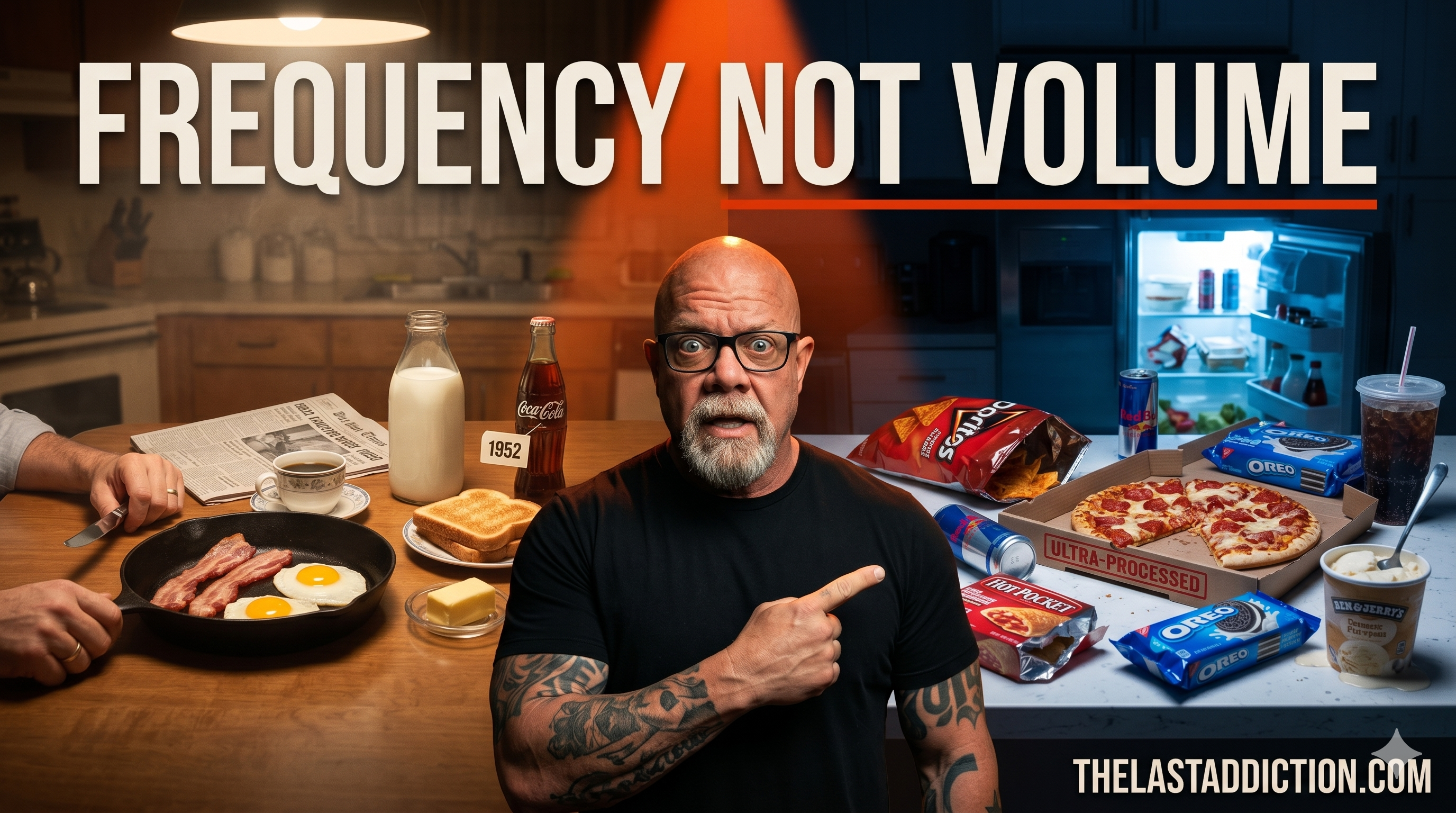
Pull up a black-and-white photo of any American street corner from 1952. Look at the bodies. Now drive past a Costco parking lot today. The two countries are not the same shape.
The lazy answer is that the 1950s walked more. Maybe. The other lazy answer is that food was scarcer. Sometimes. The Great Depression had ended a decade earlier and the post-war boom was running. People ate butter on white bread, full-fat milk, bacon at breakfast, steak at dinner, and they smoked five packs a day on top of it. By every modern dietary commandment they should have looked worse than we do. They looked better.
The variable that changed is not what they ate. It is how often.
Three meals a day was a thing. Snacks were not really a thing. Drive-throughs were not yet on every corner. Vending machines were a curiosity. The 11pm refrigerator raid did not exist as a daily ritual because the refrigerator did not have anything in it engineered to seduce you at 11pm. People ate, then they stopped eating, and then a long stretch of time passed before they ate again. Their bodies got hours of every day to do the work of not digesting. We do not give our bodies that anymore. Almost ever.
That is the thesis. Hold on to it. Everything below is downstream of that single sentence.
The TV Lie We All Bought
For thirty years, the only public message about weight has been some version of eat less and move more. It sounds reasonable. It sounds like math. It is also, in practice, the worst possible advice for most of the people it is given to, and the reason it is the worst is hiding in plain sight.
When you eat less, your body is not fooled. It does not think you have made a noble decision to take charge of your health. It thinks food has gotten harder to find. Your body has been doing this routine for two hundred thousand years, and the response is automatic. The thermostat turns down. The metabolism that was burning at one rate now burns at a slower rate, because the system that kept your ancestors alive through famine after famine is the same system you are running today.
Now you are eating less and burning less. The deficit you thought you created has shrunk. So you eat a little less. Your body shrinks the burn a little more. The treadmill speeds up. The scale stops moving. You give up. You go back to your old eating, except now you are eating it on top of a metabolism that has quietly downshifted, and the weight you lost comes back, and a few extra friends come back with it.
The cardio half of the prescription is a different lie wearing the same uniform. Look at what your watch says you burned on a half-hour walk. The number is more flattering the larger you are, which is why the people who need it most are encouraged the most. Strap the watch on a four-hundred-pound person and the calorie counter looks heroic. Strap it on someone who actually has twenty pounds to lose and the workout reads like a dietary rounding error. You can earn back forty-five minutes of treadmill in ninety seconds at the snack aisle.
The "metabolic adaptation" piece is not a hot take. Leibel and colleagues published it in 1995 in the New England Journal of Medicine. After meaningful weight loss, the body burns roughly 15 percent fewer calories than predicted, and that suppression sticks around. Your body remembers the diet. The diet does not remember you.
The Drugs Are Rented Fasting
The GLP-1 family. Ozempic. Wegovy. Mounjaro. Zepbound. The before-and-after photos are real. The mechanism is interesting. The conclusion most people draw from the photos is wrong.
The drugs do two things. They slow gastric emptying so food stays in your stomach longer. And they suppress ghrelin, the hormone your gut sends to your brain when it is time to want food. Slow the stomach down, quiet the hunger signal, and what happens is the same thing that happens to a person who fasts on purpose. You eat less. You eat less often. You spend more hours of the day in a non-fed state.
The drug is a rented version of the thing your body already does for free. We are paying twelve hundred dollars a month, with side effects ranging from gastrointestinal misery to thyroid concerns, to outsource a function our biology built in. And when people stop the drug, the appetite comes back, and the weight follows it home, because the underlying behavior never changed. Nothing was learned. Nothing was rewired. A pharmaceutical babysitter held the spoon down for them.
Here is the part nobody on TV will say. If a drug works because it stops you from eating, then stopping yourself from eating works for the same reason. The drug is not the cure. The fasting is the cure. The drug is a chemical wrapper around a behavior that has existed since before there were drugs.
And A Question The Pharmacy Will Not Answer
If you take a GLP-1 drug and it suppresses your appetite, do you still get the rest of the fasting cascade for free? The autophagy. The growth hormone surge. The ketone production. The stem cell signal. Or does the drug only block the calorie part and skip the cellular cleanup that is, in the long run, the actual point?
I am not a doctor. I am not your doctor. I am asking questions out loud that most of the people prescribing this drug do not seem to be asking back. If you are on a GLP-1, do not stop because of a blog post. Talk to the human with the prescription pad. But ask them this one question.
The Sugar Is Hiding In Your Spaghetti
Walk down the bread aisle and read the labels. Wonder Bread. No sugar. White rolls. No sugar. A box of pasta. No sugar. Crackers. Often no sugar.
You have been trained to look for the word sugar on a label. The food industry knows this. So they hide the sugar in plain sight by giving it different names and different forms. The most expensive piece of misdirection in the modern grocery store is the carbohydrate that does not call itself sugar.
Your body cannot read labels. Your body reads molecules. A bowl of spaghetti hits your bloodstream as glucose. A loaf of white bread hits your bloodstream as glucose. A bowl of granola, a bagel, a corn tortilla, a vending-machine pretzel, a "healthy" rice cake. All of these are sugar wearing a costume. The pancreas does not care what the costume looks like. It releases insulin. Insulin is the storage hormone. Storage means fat.
This is the piece Dr. Jason Fung talks about over and over, and it is the piece almost nobody listens to until they have failed at every other approach. The carbohydrate is not the enemy because carbohydrate is evil. The carbohydrate is the enemy because every time you eat one your insulin runs the storage routine, and if you eat carbohydrate every two hours your insulin never gets to stop running the storage routine, and stored fat is locked behind that hormone.
People will fight you on this with the natural-versus-processed argument. What about an apple? An apple is fine. An apple is also nothing like a glass of apple juice, and a glass of apple juice is closer to a Coke than your dietitian wants to tell you. I have done a glass of apple juice. The next morning my joints hurt. My knees were stiff. My fingers were puffy. That was a sugar overdose dressed up as a health drink, and my body was not confused about the costume.
The fiber-bound argument has some truth in it for some people. For me, an addict, the apple is fine but the apple juice is not, and the cookies after the apple are the real story, because the apple flipped the dopamine switch and now the brain is asking for more, and the brain has a very good memory for foods that have hit that switch in the past.
The Tank You Never Empty
Here is the part of the metabolism story that almost no diet program will tell you, because if you understood it you would not need the program.
Your body has two fuel systems. The first runs on glucose. The second runs on fat. You are designed to switch between them depending on what is available. You can store about two thousand calories of glucose in your liver and muscles, give or take, depending on size and training. You can store hundreds of thousands of calories of fat. The fat is supposed to be the long-haul tank. It is the reason your ancestors survived winters where the deer were thin and the berries were gone.
The switch from one tank to the other does not happen until the first tank is close to empty. For most people that is somewhere between sixteen and thirty-six hours of not eating. The reason most people never burn body fat is not that their body refuses to burn fat. The reason is that they never get to the switch. They never go long enough without eating for the glucose tank to drain. They live in the fed state. They top off the glucose tank every two or three hours from the moment they wake up to the moment they fall asleep, and the body never gets the signal that says it is time to go to the other tank.
The "breakfast is the most important meal of the day" line was not handed down from a mountain. It was handed down from a cereal company. Break-fast. Two words. The fast is the part that mattered. The breakfast is just the meal that ends the fast. We collapsed the two words into one and forgot the order of operations. Ending the fast is not more important than the fast. The fast is the part that does the work. The meal just stops it.
The Addiction Nobody Wants To Name
I am not addicted to spaghetti the way an alcoholic is addicted to vodka. I am addicted to it in exactly the way an alcoholic is addicted to vodka. This is the part of the conversation people will not have, because it sounds dramatic, and because admitting you are addicted to food sounds weaker than admitting you are addicted to a substance with a skull and crossbones on the bottle.
The neuroscience does not care how it sounds. The same dopamine pathways that light up for cocaine light up for refined carbohydrate and sugar. The bliss point engineers at the food companies are using the same playbook the cigarette companies used, and they are doing it with bigger budgets and better data. The reason you cannot have just one chip is the same reason an alcoholic cannot have just one drink. The first hit is not the problem. The first hit is the trapdoor that opens onto the rest of the bag.
An alcoholic walks into a room and people do not hand him a beer and say just have one. Nobody does that. They know better. They do it for the food addict every single time. Birthday cake. Donuts at the meeting. Pizza after the soccer game. Cookies in the breakroom. The infrastructure around food addiction is actively, cheerfully hostile to recovery, because nobody is willing to say food addiction is real.
This is the room I am building at TheLastAddiction.com. AA exists. NA exists. Gamblers Anonymous exists. There is no room for food addicts where the door says food addict on it. So the room is here. Free entry. No drink in your hand at the door.
The Supermarket Cart Doesn't Lie
I am a cart watcher at the grocery store. I have been one for years. I do not stare. I do not judge to anyone's face. But I look. And the cart tells the truth about the body that is pushing it almost every single time.
The carts I used to push were a confession in plastic and cardboard. Microwave burritos. Bags of chips in three different flavors. Hot Pockets. Frozen pizzas with names that sounded like fast food. Crackers. Cookies. Chocolate. A two-liter of soda. Maybe one head of lettuce on top, like a fig leaf to make the rest of the cart look respectable. There was almost never a piece of meat that had not been pre-formed into a shape. There was almost never a vegetable that did not come in a box.
The carts that belong to the lean fifty-year-olds at the same store look completely different. Eggs. Bags of vegetables. A whole chicken. Olive oil. Plain yogurt. A pound of beef. Maybe some cheese. Maybe one indulgent thing. The cart is short. The cart is boring. The cart is full of food that has one ingredient.
One ingredient. Egg. Beef. Chicken. Salmon. Sardines. Lettuce. Tomato. Avocado. Olive oil. Real butter. Salt. Pepper. The whole protocol is in that list. If a food has more than one ingredient on the label, decide on purpose whether to buy it. If a food has thirty ingredients on the label, half of which you cannot pronounce, you are buying somebody else's chemistry experiment.
The Eggs Are Cheaper Than The Lie
Eggs are a dollar-eighty a dozen at the moment, in most stores. A dozen eggs is roughly nine hundred calories of complete protein, with most of the fat-soluble vitamins your body actually needs, and the fat is the fat your brain runs on. A bag of chips is the same price and you cannot live on it for an afternoon, much less a week. The food that is worst for you is the cheapest only in a very narrow definition of cost. Run the cost out to a doctor visit, a prescription, a medical event, and the chips are not cheap. The chips are the most expensive thing in the cart. You just paid for them on a different ledger.
Chew Until Your Jaw Hurts
Here is one of the simplest, oldest, free interventions that almost nobody does anymore. Chew your food.
Not chew it like a normal person. Chew it like an old yogi. Chew it until it is liquid in your mouth before you swallow. Fifty, sixty, seventy times per bite. Chew it until you feel like you are drinking your meal. The word for this is mastication. The benefits are not mystical. Better digestion. Better satiety signals from your gut to your brain in time to actually feel full before the plate is empty. Stronger jaw, stronger teeth, more saturated taste, less stress on the rest of the digestive tract.
Try it for one meal and pay attention to two things. First, you will eat less. The body's full signal arrives roughly twenty minutes after the food does, and most of us are done eating before the signal is sent. Slowing the bite count down lets the signal catch up. Second, you will notice that the food you cannot chew that long is exactly the food that is not really food. A piece of pizza is hard to chew sixty times. A cookie disappears in three. The food engineered to bypass your fullness reflex is the food that punishes you for trying to slow it down. The food your body actually wants you to eat is the food that holds up under the chewing.
So What Do You Actually Do
Not a prescription. Not medical advice. I am not a doctor. I am sitting in the same room as you. Here is what has worked for me, going from three hundred sixty-five pounds and a sixty-five-inch waist to where I am now, which is the thirty-eights and headed for the thirty-fours.
Compress the eating window first. Not the calories. The window. Take whatever scattered eating pattern you have right now and gather all the food into a four to six hour window. The hours outside the window are water, black coffee, plain tea. Do not negotiate with yourself about cream. Do not negotiate about diet sodas. Just water and coffee. The window does most of the work for you. Your body finally gets sixteen, eighteen, twenty hours a day to do the metabolic work it has been begging to do.
Eat one-ingredient food when the window is open. Eggs. Meat. Fish. Vegetables. Salt. Pepper. Olive oil or butter. Maybe some cheese. That is it. No bread. No pasta. No "just one cookie." No granola bar that calls itself a protein bar. The longer you do this the more you will notice that the cravings actually quiet down, because you stopped pulling the lever every two hours.
Push the window further when you are ready. One meal a day. Then a thirty-six-hour fast on the weekend. Then a forty-eight. The intervals get easier the more often you do them, because your body literally rewires its preferred fuel source. After a few weeks the switch from glucose to fat happens faster, and the in-between hours stop feeling like a fight.
Refeed like an adult. When you break a long fast, you do not break it on pizza. You do not break it on ice cream. You break it on a small portion of real food. Eggs. A piece of meat. Some vegetables. The reason is partly biological, your gut needs to ramp back up gently, and partly behavioral. The whole point is to teach yourself you can have a long fast and not punish your body when it ends. The refeed is the report card.
Stop giving the bad food farewell parties. The night before a new protocol. The "last hurrah." The "one more time before I really start." Every farewell party is a relapse with a sentimental soundtrack. There is no farewell. There is just the next meal, and you decide what is on the plate.
The Long Game
The thesis is small. Frequency is the variable nobody is testing. The 1950s ate richer food than we eat and looked leaner because they ate it less often. We compressed our eating window from two meals a day to a permanent grazing pattern, and we are paying for it with a chronic-disease epidemic that all the diet drugs in the world will not fix as long as the underlying behavior stays the same.
You do not need to take my word for it. You have a body. Run the experiment for thirty days. Compress the eating window. Eat real food when the window is open. Watch what happens to your weight, your sleep, your joints, your mood, your skin, your money, your life.
The thing they do not tell you is that the work is not the eating. The work is the not eating. And the not eating gets easier every day you practice it, because the addiction loosens its grip every single time you do not feed it.
That is the door. Go through it.
Connor MacIvor is documenting his food addiction recovery at TheLastAddiction.com. He is not a doctor. None of this is medical advice. Talk to your doctor before changing how you eat, especially if you take medication for blood sugar, blood pressure, or thyroid. The goal of this site is to put words to an experience that does not have enough words attached to it yet.